Cheap Retaining Wall Ideas: 8 Approaches Under $30 per Square Foot (Including Gabion)
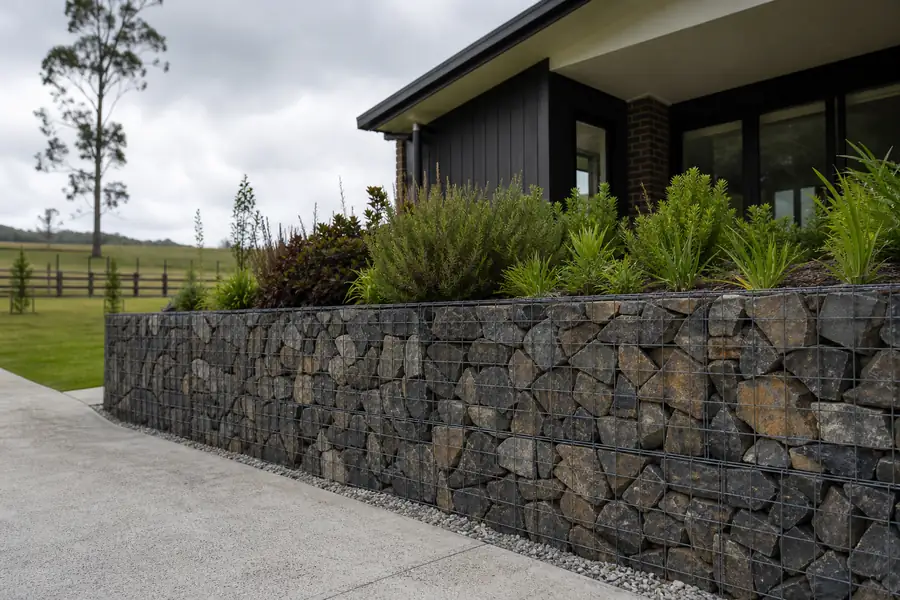
Quick answer: Dry-stacked riprap and large river rock gravity walls run cheapest, typically $8 to $18 per square foot installed, but both need excavator access to place the stone. Gabion walls land at $15 to $25 per square foot and work well on tight sites with no equipment access. Timber, dry-stacked fieldstone, and segmental concrete block fall between $15 and $30 per square foot depending on height and finish.
Cost per square foot moves with three things: wall height, how far the stone has to travel, and whether a machine can reach the cut. A 30 foot long, 3 foot tall wall has 90 square feet of face. At $12 per square foot for a riprap gravity wall, that's roughly $1,080 installed. The same footprint in poured concrete can run $2,700 or more once forms and rebar are in.
For a full breakdown of labor, permits, and material costs by wall type, see our guide on retaining wall cost. The ranking below sorts the eight most common budget approaches by installed cost per square foot, cheapest first.
Cheap retaining wall ideas ranked by cost per square foot
Regrading a slope with geogrid and ground cover is the cheapest fix because there's no stone or structure to buy at all. Every option below gets more expensive as height, labor, or material cost climbs.
| Approach | Installed cost per sq ft | Best for |
|---|---|---|
| Regraded slope with geogrid | $5 to $12 | Slopes under 3 ft you can batter back 2:1 |
| Riprap gravity wall | $8 to $15 | Short walls up to 4 ft with machine access |
| Large river rock wall | $10 to $18 | Decorative walls under 3 ft near a stone source |
| Railroad tie or timber wall | $15 to $22 | Straight walls under 4 ft needing a fast build |
| Gabion wall | $15 to $25 | Tight sites with no equipment access, walls up to 6 ft |
| Crib wall, crushed stone fill | $18 to $26 | Walls over 4 ft needing built-in drainage |
| Dry-stacked fieldstone | $20 to $28 | Decorative garden walls under 3 ft |
| Segmental concrete block | $22 to $30 | Walls up to 4 ft needing a uniform finished look |
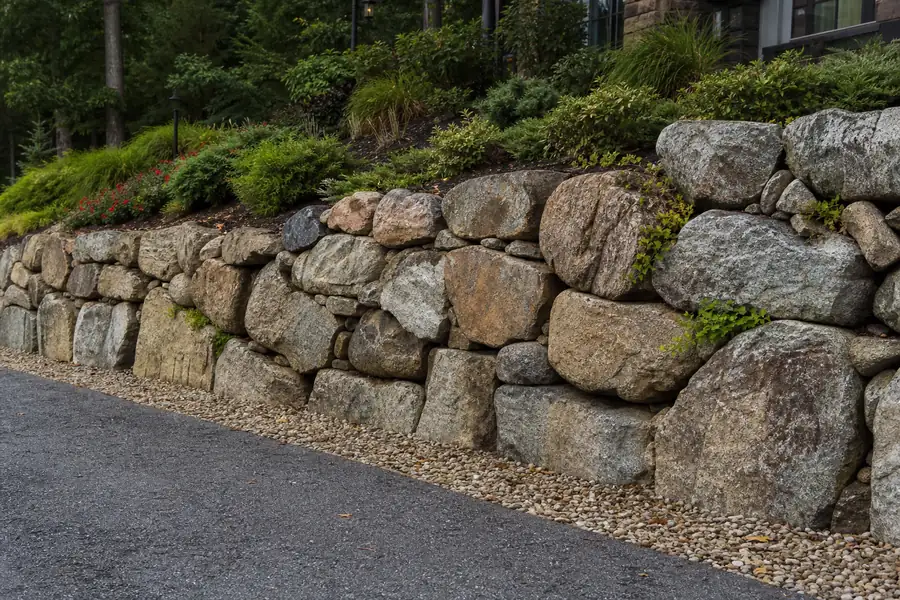
Riprap and large river rock gravity walls sit at the bottom of the table because they skip cages, mortar, and precast units. You stack angular stone or large river rock against the cut and let its own weight and friction hold the slope. Both need an excavator or skid steer to place stone over about 50 pounds, so price in equipment access before you lock in the lowest number on the table. Riprap works best where the wall stays under 4 feet and the truck can dump close to the wall line.
What stone fills a gabion wall?
Gabion cages call for angular crushed stone sized 3 to 5 inches across, never rounded pea gravel or sand, because the sharp faces interlock and resist settling. Rounded stone rolls past itself inside the cage and leaves voids that let the wall slump. 4 crushed stone, which runs roughly 2.5 to 4 inches, is the closest standard grade and stays put against a 2x1 inch mesh opening without working through.
Behind the cage, backfill with free-draining crushed stone and a layer of geotextile fabric so soil fines don't migrate into the fill and clog it over time. Our retaining wall drainage and backfill spec covers the exact lift thickness and pipe placement for gabion and crib walls alike.
Do you need equipment access for these walls?
Riprap, large river rock, and crib walls need a machine that can swing stone into position, so a yard with no gate wider than 36 inches rules those three out. Gabion, timber, dry-stacked fieldstone, and segmental block can all be built by hand, one basket or course at a time, which is why they land higher per square foot on labor even though the material itself can cost less.
On steep lots in Colorado, where driveways switchback above the building pad, a mini excavator often can't reach the wall line at all. That pushes gabion or hand-stacked fieldstone ahead of a cheaper riprap gravity wall, even though riprap wins on the cost table.
In freeze-thaw climates like Minnesota, skipping drainage behind any of these walls costs more than the wall itself. Water trapped in clay backfill freezes, expands, and pushes the face out over a few winters, turning a $15 per square foot wall into a full rebuild within a decade.
Before you order
- Measure the finished wall face in square feet (length times height), not the yard behind it.
- Dig a buried base course 6 to 12 inches below grade so frost and runoff can't undercut the first row.
- Match fill stone to wall type: angular crushed stone for gabions and crib walls, riprap or river rock for gravity walls.
- Add 10 percent extra stone to cover settling and uneven courses.
- Run your volume through the riprap calculator before you order so the delivery matches the wall, not a guess.
FAQs
Can you build a retaining wall without hiring an excavator?
Yes. Gabion, timber, dry-stacked fieldstone, and segmental block walls can all be built by hand, one basket or course at a time. Riprap, large river rock, and crib walls generally need a machine to place stone over 50 pounds, so hand-built options cost more in labor but save on equipment rental.
What size stone goes inside a gabion wall?
Most gabion cages call for angular crushed stone between 3 and 5 inches across, close to a 4 crushed stone grade, because the sharp faces interlock and resist settling. Rounded stone like pea gravel or river rock is too small and migrates through the wire mesh over time.
Do cheap retaining walls still need drainage?
Yes. Every wall type on this list needs free-draining backfill and often a perforated pipe at the base, because trapped water is the main reason low-cost walls fail early. Skipping drainage to save a few dollars per square foot usually costs more in repairs within a few years.

Fifteen years in bulk aggregate supply taught Derek Malone to ask the boring questions before the expensive ones: how deep, how much, what's underneath. He works out of Kansas City, scheduling deliveries through winters that freeze the ground solid and summers dry enough to crack it. That swing is why he treats climate as part of the math, not an afterthought. He's seen enough driveways fail within a year to know a good-looking stone and a good stone aren't always the same thing.


