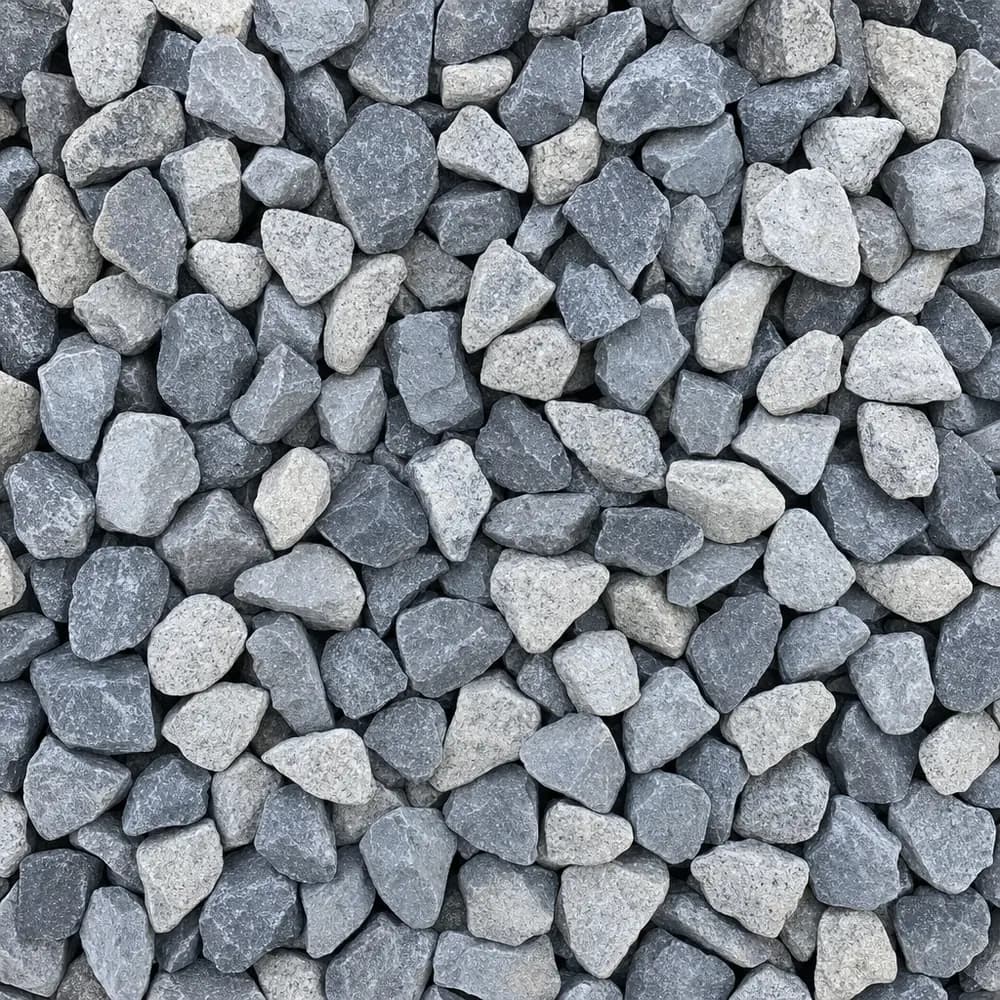
Railroad Ballast: The Largest Stone You Can Still Grade Flat
Also known as: Ballast Stone, Track Ballast, Rail Ballast
Large angular railroad ballast, roughly 1 inch to 2.5 inches. Heavy crushed stone built to bear load and drain fast under rail track, heavy equipment pads, and access roads.
From $429 for 1 ton, delivery to 16022 included (larger loads cost significantly less per ton)
Free delivery included
Enter your ZIP to see your competitive price
Delivered to 16022
Pick a delivery date
Weekday delivery, earliest Nov 3
“This is serious rock. I used it for a retaining wall base and it's not going anywhere. It feels very solid.”
Rob K. · Verified Buyer
Get a Free Quote
Fill out the form and our sales team will get back to you within the hour.
Ground that carries heavy loads fails in different ways depending on where it sits: frost heave through a northern winter, a saturated subgrade through a southern rainy season, salt-damp sand near the coast. The repair is the same in all three, and it is usually a bigger stone than the owner first ordered. Railroad ballast is where that scaling-up stops, because it is the largest size that still spreads and grades into a working surface rather than a pile of rocks.
Pieces run roughly 1 inch to 2.5 inches, angular, graded to interlock while water runs straight through. Beyond the rail bed it goes under equipment pads, laydown yards and access roads.
Railroad ballast, #4 stone and riprap next to each other on soft ground
These three get substituted for one another constantly, and they behave nothing alike.
| Catalogue product | Rough size | What it is doing |
|---|---|---|
| Railroad Ballast | 1 to 2.5 in, angular | Load-bearing layer that still grades flat |
| #4 Crushed Stone | Large graded stone | Heavy base and erosion work where smaller sizes move |
| RipRap | 4 to 12 in | Armor placed against moving water, never graded flat |
Riprap is placed, not spread. It is sized to resist water, not to carry a wheel, and a pad built from it stays lumpy forever. The step from a graded number to ballast is smaller, and it comes down to how much weight crosses the surface and how often.
The lane or the yard that goes soft under every loaded truck
The job this material is bought for is a surface that has already failed once. A farm lane that turns to soup for a month each year. A laydown area where a truck idling in one spot sinks. A gate approach that ruts faster than it can be regraded.
Smaller gravel fails there for a predictable reason. Fine material mixes with the soft subgrade below, the layer thins where the load concentrates, and within a season the stone has been pushed down into the ground rather than sitting on it. A large angular piece is too big to be swallowed that way, and the interlock between pieces spreads a wheel load across a wider footprint of subgrade.
Frozen ground in the north, saturated subgrade in the rainy south
Ballast solves both by holding almost no water. In the frost belt, where codes run frost depth as deep as 48 inches in Massachusetts, New Hampshire and Wisconsin, a layer holding water is a layer that lifts and drops every winter. Large open stone drains before it can freeze solid, so the surface moves far less.
In the wet south and on the coast, the same open structure keeps the layer from turning into a saturated sponge sitting on saturated clay. The stone stays a stone layer instead of becoming part of the mud beneath it.
Laying it in one lift, over fabric, with a bucket rather than a roller
The install is short but unforgiving of shortcuts.
Strip the organic material and any soft, churned-up surface first. Lay a separation fabric across the subgrade: on soft ground this is what keeps stone and soil apart, and without it the first winter mixes them. Bring the ballast in and spread it in a single lift, working off the stone you have already placed rather than driving on the bare subgrade. Grade with a bucket or a box blade, dragging back and forth to knock high pieces down into the gaps.
Then stop. A plate compactor cannot do anything useful with 2 inch pieces. What settles this material is traffic, and the surface will tighten over the first few weeks of use.
Why a playground is the one place this stone should never land
The temptation is understandable, since the drainage is excellent and one load covers a lot of ground. It is still wrong. Pieces this size are sharp-edged, heavy enough to be thrown, and impossible to fall onto safely. Nothing about the size suits bare feet or small hands.
Play surfaces want something that absorbs a fall or is smooth underfoot, which means Shredded Mulch or 3/8" Natural Pea Gravel.
When a smaller stone is the better lane after all
Two alternatives are worth weighing before committing to this size.
Crusher Run packs into a firm, tight surface because it carries fines, and it is far more comfortable to walk, wheel a wheelbarrow over and drive a car on. It is the better answer for a lane used by ordinary vehicles on ground that is merely firm.
Road Base does the same job where a finished surface is going over the top later.
The honest division is this: ballast where the ground has already proven it cannot carry the load, a compactable blend where it can. Many lanes end up with both, ballast as the bottom layer in the worst stretch and a finer surface course over it, which is the only way to get a soft section carrying weight and still pleasant to use.
Tons for a 250 foot lane and a 14 by 40 foot pad
Quantities here get large quickly, so work them before booking anything.
The lane. A 250 foot stretch, 10 feet wide, at 6 inches: 250 x 10 = 2,500 square feet, 2,500 x 6 / 12 = 1,250 cubic feet, 1,250 / 27 = 46.3 cubic yards. This site figures ballast and #4 stone at about 2,900 lb per cubic yard, or 1.45 tons per yard, so 46.3 x 1.45 is roughly 67 tons.
The pad. A hypothetical RV or boat pad at 14 by 40 feet, also 6 inches deep: 14 x 40 = 560 square feet, 560 x 6 / 12 = 280 cubic feet, 280 / 27 = 10.37 cubic yards, about 15 tons.
Both figures are for the stone only. Ground that has already rutted needs more, because the ruts are volume too, and filling them is what the first few tons actually do. Run your own dimensions through the stone calculator, which takes up to five areas so a lane with two bad stretches can be figured in one go.
Getting a large load onto the part of the site that needs it
Order in tons, round up, and think about where the pile lands. Stone this size cannot be shoveled comfortably, so a drop that a loader or a tractor bucket can reach is worth more than a drop close to the work.
Delivery is arranged at checkout by ZIP code, and a heavily loaded truck needs a firm approach, which on a soft site may mean dumping at the road and moving the material in yourself. Set the tonnage and the date on this product page. For a lane with several failed stretches, send the lengths and widths through the contact page and ask for a quote by email rather than guessing at a single figure.
Quickly Calculate How Much You Need
Material: Railroad Ballast
How to Measure
Measure the length and width of your project area in feet
Decide on depth in inches (2" for landscaping, 4" for driveways)
Enter the values above and we'll calculate the tonnage you need
Need help figuring out the right amount? We can help!
Call or text us at (888) 389-5517 and we'll help you calculate the right quantity for your project.
Not sure how much you need? The Stone Calculator has depth guides, coverage charts and worked examples for this material.
Frequently Asked Questions About Railroad Ballast
Customer Reviews
Needed something heavy enough to stop erosion along a drainage ditch behind the property. This ballast did the trick, dense rock, settled well, hasn't shifted with runoff.
Tony J. · Scottsdale, AZ · Verified Buyer
Went with American Rock Supply for a load of ballast to shore up a slope that kept washing out. Really happy with how it turned out, the stone locked in place and hasn't budged through two storms since.
Scott C. · Fort Myers, FL · Verified Buyer
Material itself is good, heavy angular ballast that packed down nicely under the shed pad we built.
Nicole K. · Kansas City, MO · Verified Buyer
Heavy duty stuff
This is serious rock. I used it for a retaining wall base and it's not going anywhere. It feels very solid.
Rob K. · Fort Myers, FL · Verified Buyer
Good for a base
I used this under a heavy shed and it hasn't moved. Very solid stuff.
Ryan E. · Birmingham, AL · Verified Buyer
Dependable material for the project
This worked well for a retaining wall base. It's heavy and locks together nicely.
Dana P. · Tucson, AZ · Verified Buyer
Dependable material for the project
The railroad ballast arrived as described and performed reliably for the job.
Mike D. · Savannah, GA · Verified Buyer
Dependable material for the project
It's railroad ballast. It's heavy and angular, and it locks together well. No surprises.
Tom V. · Indianapolis, IN · Verified Buyer
Solid base
I used this as a base for a heavy equipment pad. It compacted well and hasn't shifted under load.
Diane W. · Raleigh, NC · Verified Buyer
Easy From Start to Finish
My order with American Rock Supply was simple and straightforward. The railroad ballast was consistent and easy to use. The experience was simple, professional, and well organized.
Lisa W. · Tulsa, OK · Verified Buyer
Railroad Ballast has 10 verified customer reviews with an average rating of 4.8 out of 5.